【レポート】ジョナス・メカスの吐息【Report】A WHISPERED BREATH OF JONAS MEKAS
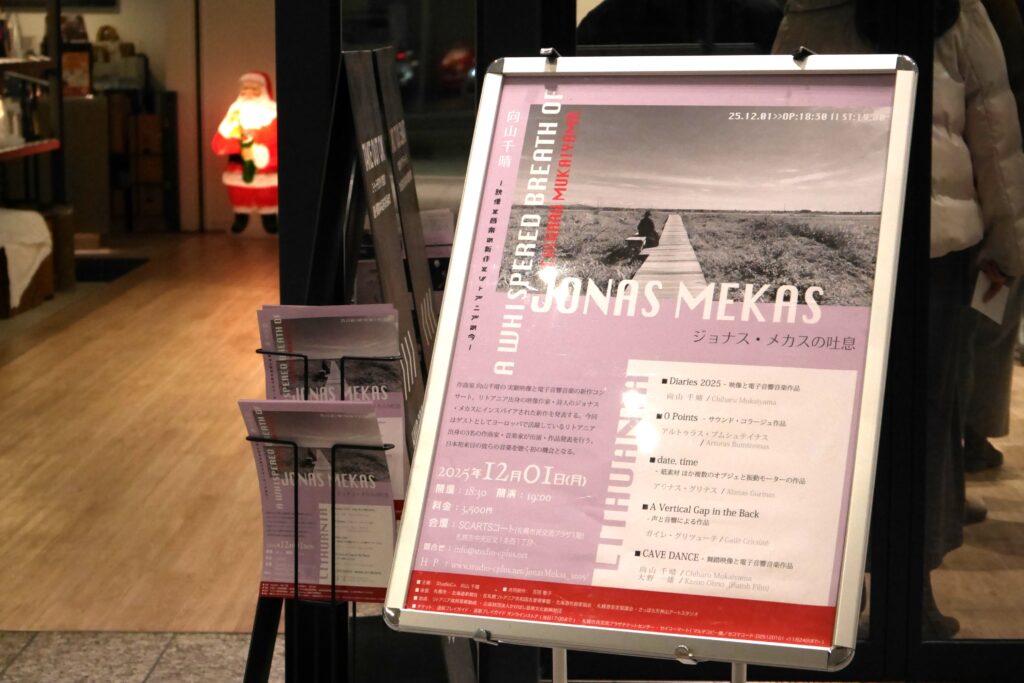
去る2025年12月1日、札幌文化芸術交流センター SCARTSで『ジョナス・メカスの吐息 A Whispered Breath of Jonas Mekas ——映像と音楽の新作とリトアニアの今——』が開催されました。
このイベントで、さっぽろ天神山アートスタジオに滞在中のアーティスト3名(アルトゥラス・ブムシュテイナス、アラナス・グリナス、ガイレ・グリツューテ)が映像とサウンド作品を発表しました。
リトアニア出身のジョナス・メカス(Jonas Mekas, 1922-2019)にインスパイアされた向山千晴さんの映像作品を中心とするプログラム構成でしたが、生前のメカスと交流があったブムシュテイナスさんを始め、招聘された現代リトアニアのアーティストによる作品にはどれも風通しのよさと真摯さが感じられました。
ここからは、リトアニア関連の作品を取り上げて、みなさんにご紹介します。
On December 1, 2025, the performance and screening event ‘A Whispered Breath of Jonas Mekas: New Video and Sound Works and Contemporary Lithuania’ was held at the Sapporo Cultural Arts Community Center, SCARTS.
During this event, three artists in residence at Sapporo Tenjinyama Art Studio—Artūras Bumšteinas, Aruanas Grinius, and Gailė Griciūtė—presented their video and sound works.
While the program centered on Chiharu Mukaiyama’s video work inspired by Lithuanian-born Jonas Mekas (1922-2019), the pieces by the invited contemporary Lithuanian artists—including Bumšteinas, who had an opportunity to see Mekas in person—all conveyed an airy openness and sincerity.
This article focuses on the works related to Lithuania and share the insights from them.
📹 向山千晴「Diaries 2025」/ “Diaries 2025” by Chiharu Mukaiyama
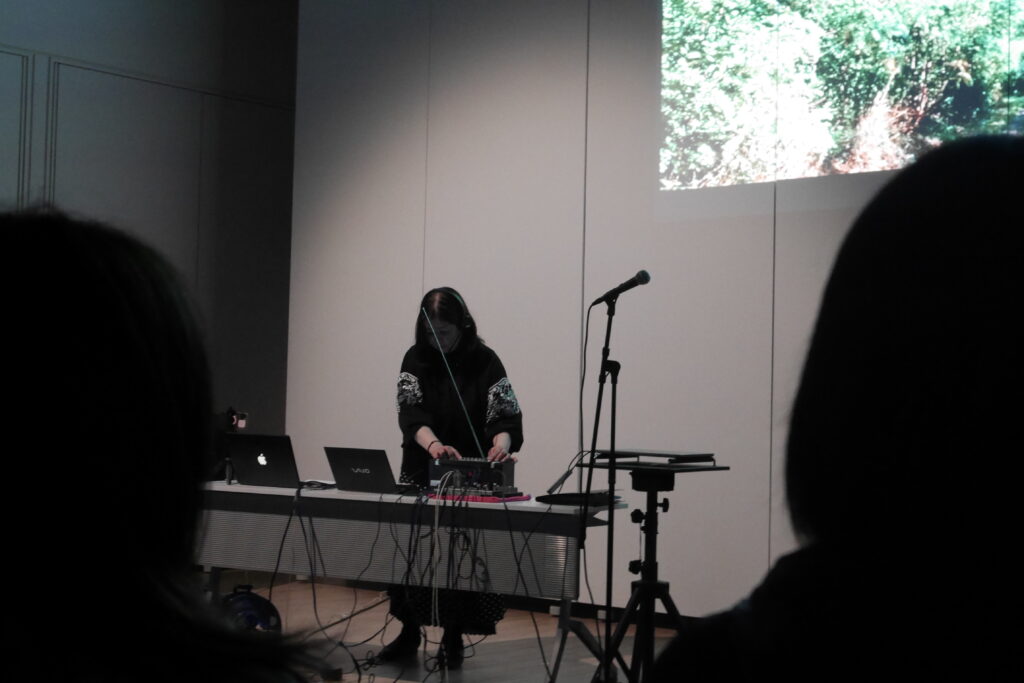
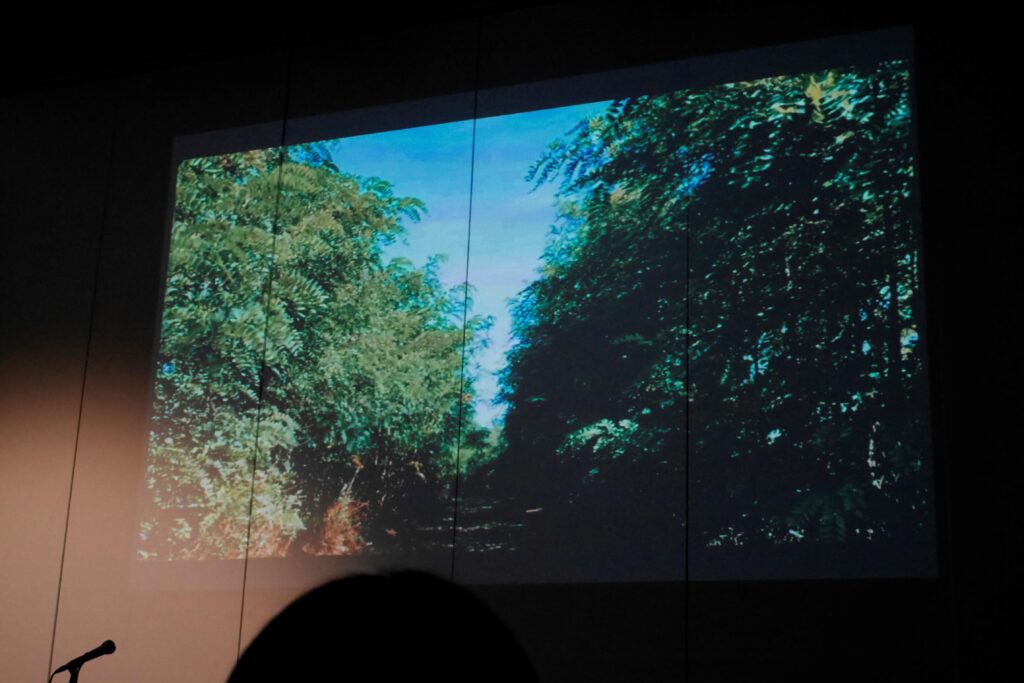
1作目は、向山さんによるメカスの「日記映画」風ヴィデオ作品「Diaries 2025」。石狩の海岸や札幌の神社、あるいはプライヴェートな邸宅空間で撮影した映像と、各所の環境音、そして構成された電子音からなる一本です。
同作はこのプログラムで唯一のメカス関連作品。各所にメカスへのオマージュが潜んでいます。たとえば180分にわたるメカスの『ウォールデン』(1969)等で印象深く使われているインタータイトルの形式(グレー背景に2~3行の黒タイプ英字)をまねて、続くシークエンスのひとこと説明が入ったり、映像編集者の独白的なものが挟み込まれたり。またヴィデオカメラ片手に撮影する自分の姿を映像に含めたり、カメラをゆっくり動かしながら大きな看板の文章を読めるように撮影しようとしたりするところにも、メカスっぽさがあります。
だけどやっぱりこれは向山さんの作品なんだなあ、とはっきり感じるのは、音の部分です。
『ウォールデン』の音世界は非常に独特で、切り貼りによるモンタージュで映像のコマ送り感が強く感じられるのと同様に、音声もしばしば録音時とは違うスピードにわざと構成し直されていたり、数分前の場面で採音された環境音が全く関係なさそうな映像と一緒に流れてきたりします。でも向山さんの作品は、基本的に音と映像が同じ環境でレコーディングされたふうで、そうじゃない箇所では明らかに環境音ではないタイプの電子音がフェードインしたりします。
メカスがよく採用した音と映像の時差は、一本の作品を見進める鑑賞者をその時差のなかへ放り投み時間のうえで前後にブレさせ続けるという形で、鑑賞者を常に複数の時間のレイヤーにさらしますが、向山さんの作品ではむしろ音と映像がぴったり符合することで、鑑賞者は逃げ込む隙なく目の前の映像に集中させられます。向山さんの映像をいさぎよくて瑞々しいと感じたのは、そんな始末のよさゆえだったかもしれません。
The first work was Mukaiyama’s video piece “Diaries 2025,” following the style of Mekas’s “diary films.” The work consists of footage shot at locations like the Ishikari coast, Sapporo shrines, and some private residences, combined with ambient sounds sampled from various locations and composed electronic sounds.
It being the only Mekas-related work in the program, homages to Mekas are hidden throughout the moving images. For instance, it mimics the intertitle format — gray background with 2-3 English lines typed in black — memorably used in Mekas’s 180-minute Walden (1969) and other diary films, providing brief explanations for subsequent sequences or inserting monologues of the video editor. Additionally, the inclusion of footage showing the filmmaker themselves shooting with a video camera in hand, or slowly moving the camera to capture text on large signs so that the audience can read it, also carries a distinct Mekas-ish quality.
After all that, what makes it unmistakably Mukaiyama’s work was its sound.
The soundscape of Walden is highly distinctive: Just as the cut-and-paste montage creates a strong sense of frame-by-frame progression in its visuals, its audio is often deliberately restructured at speeds different from the original recording. Ambient sounds captured in a scene screened minutes earlier play alongside video footage seemingly unrelated to them. Yet in Mukaiyama’s work, sound and image has a quality that convinces the audience they were recorded in the same environment; when they don’t, electronic sound that’s clearly artificial would fade in.
The time lag between sound and image in Mekas throws the viewer into the gap itself, constantly shifting them back and forth in time, exposing them to multiple temporal layers. In Mukaiyama’s work, in contrast, the precisely conforming alignment of sound and image forces the viewer to focus intently on the images before them, leaving no room for escape. Perhaps it was this very precision that made Mukaiyama’s images feel so refreshingly crisp and vivid.
⏲️アラナス・グリナス《date, time》/ “date, time” by Alanas Gurinas
2作目は、リトアニア出身アーティストのグリナスさんによるサウンド作品です。
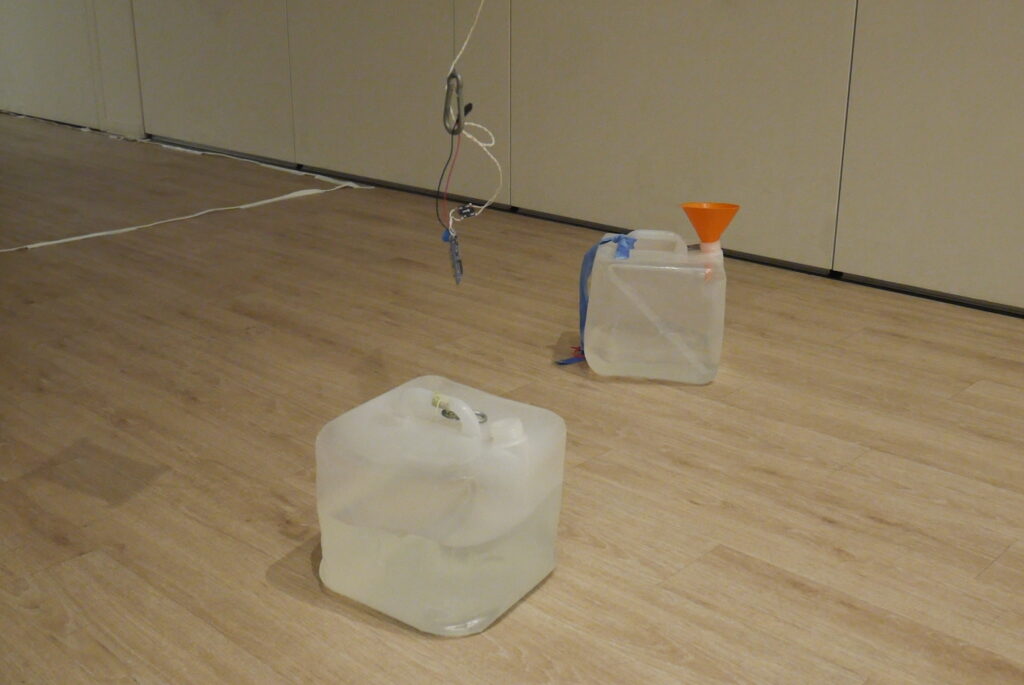
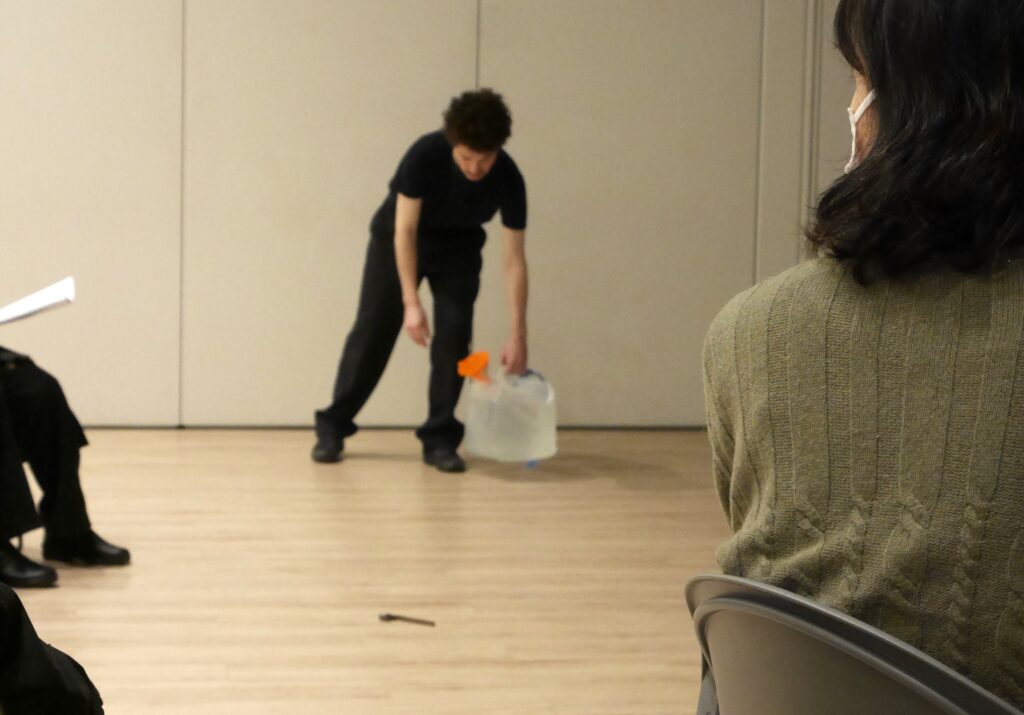
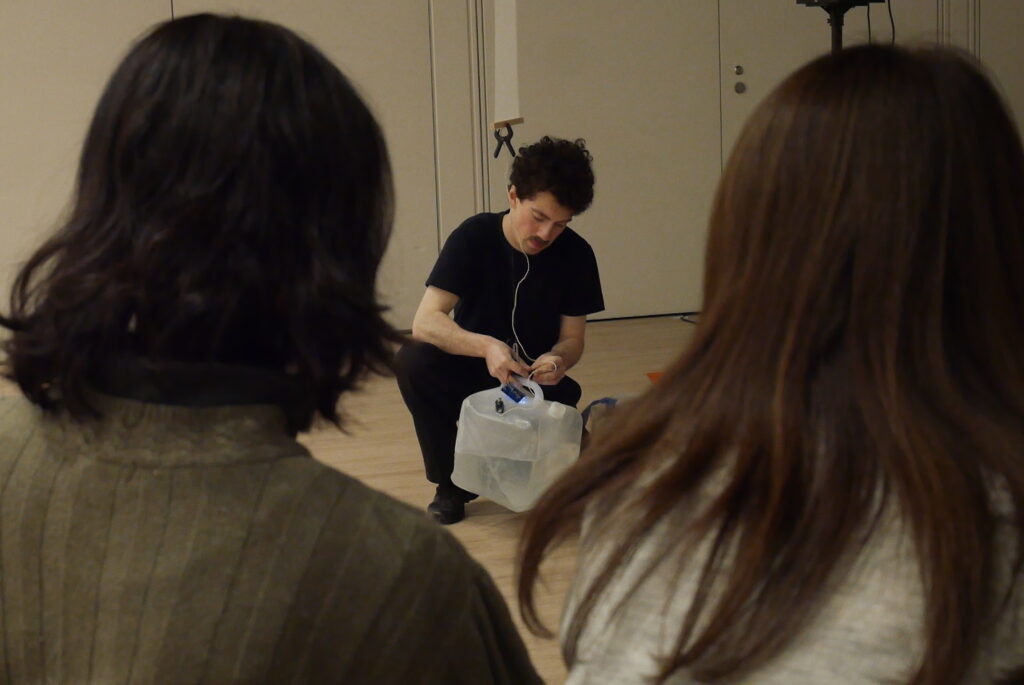
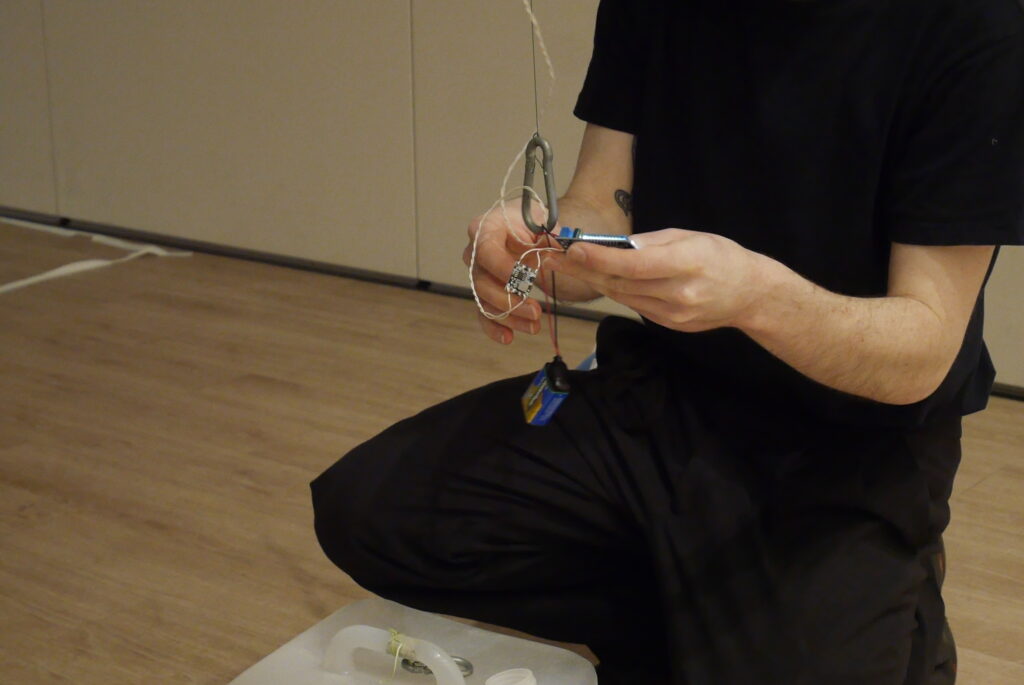
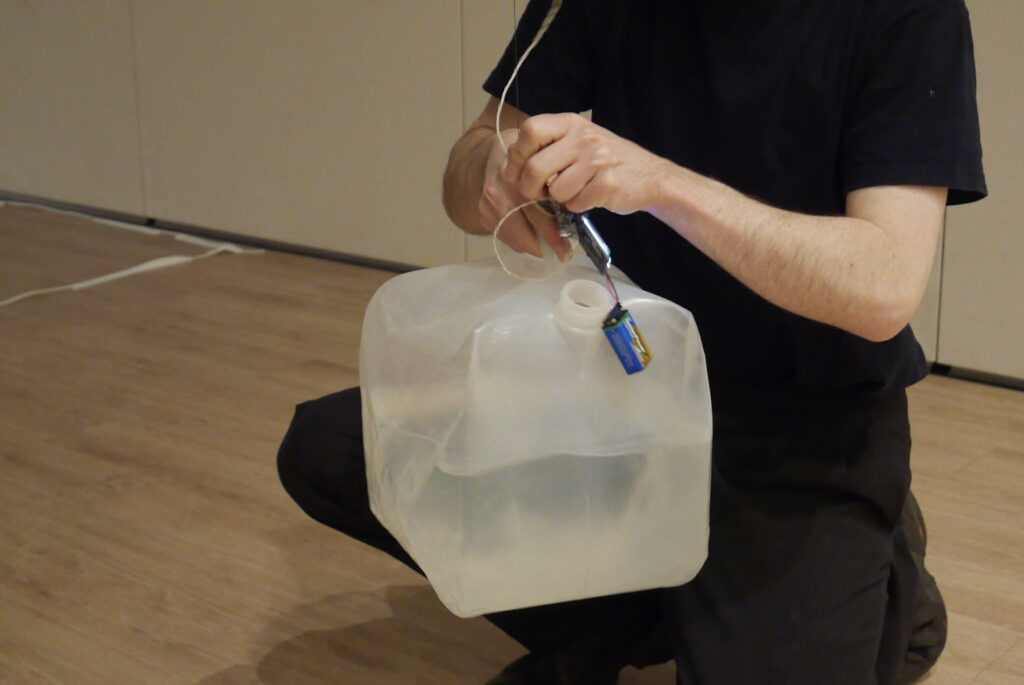
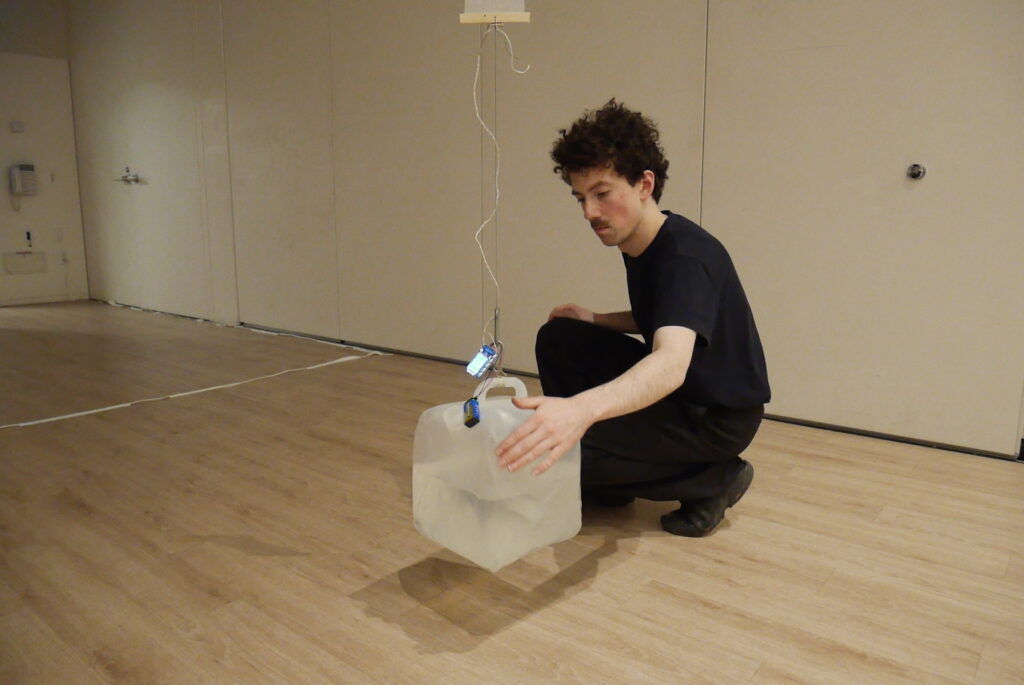
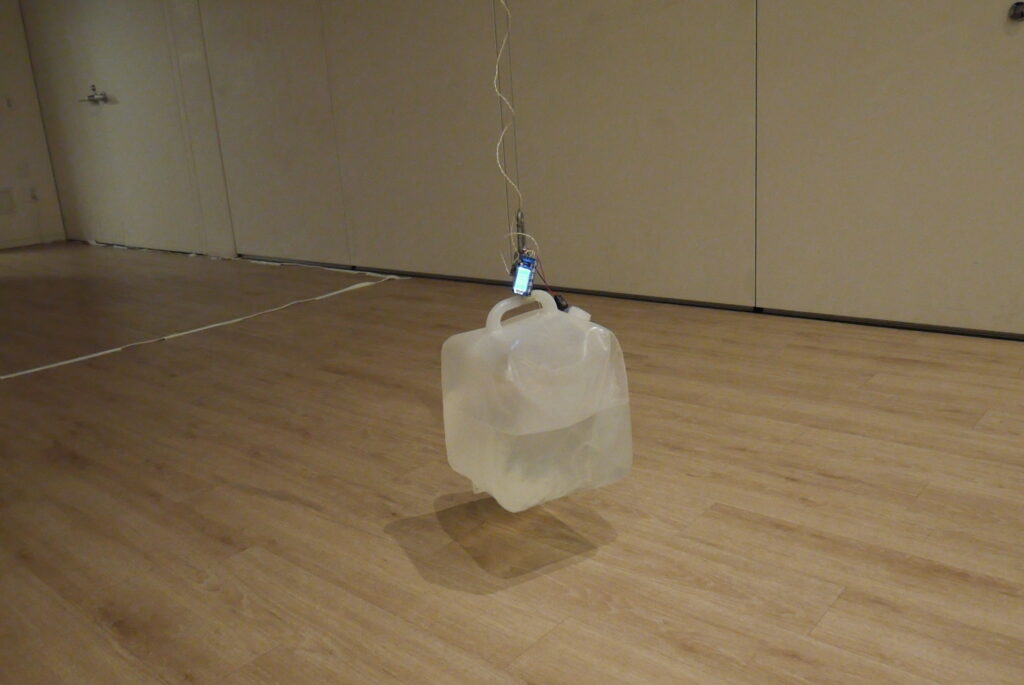
部屋じゅうに点在する乳白色のタンクたちを、アラナスさんが順番にセッティングしていきます。紙や木材、カラビナ、紐、クリップなど、日曜大工や台所で使うような日用品をじゃらじゃらつけて、天井からつるし、オレンジの漏斗つきタンクを使ってタンクに透明な液体を注ぎます。液体の量などを調節し終わったら、カラビナや紐に絡まったタイマー的なものを調節して、いったん調整終了。次のタンクのセッティングに向かいます。タンクセッティングのあいまに、バネ構造のじりじりいう虫みたいなアイテムを取り出し、床に点々と置いていくので、会場がぼんやり騒がしくなっていきます。
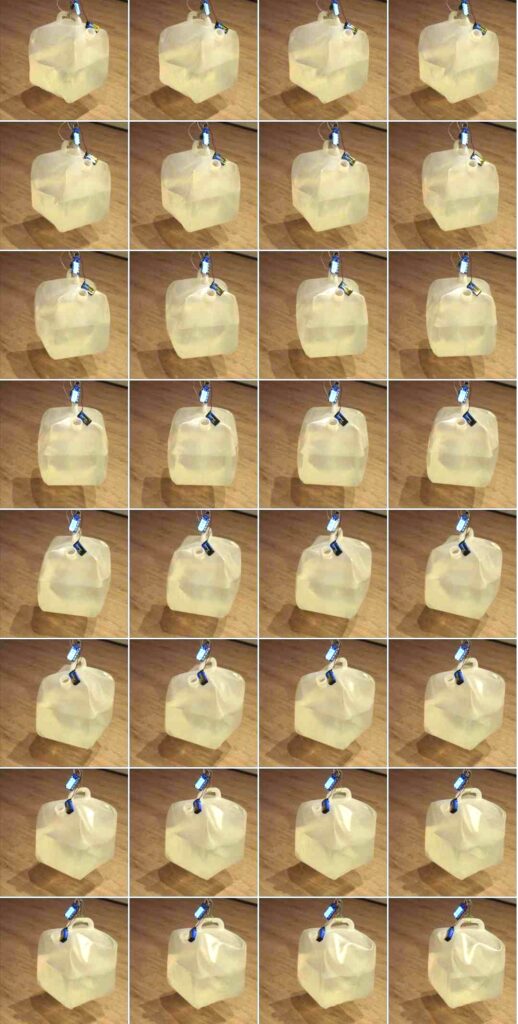
タンクのセッティングがひととおり終わるころには、会場が少し静かになり、タンクと吊り紐を繋ぐじゃらじゃら部分から低い電子音が鳴っていたことに気付かされます。タンクひとつひとつの音は小さくて響かないのですが、重奏化して存在感が増したようです。その後もタンクからタンクへわたりあるき、タンクをターザンロープみたいに揺らしたり、吊り紐を軸に回転させたり、じゃらじゃら部分の調節をしたりといそがしいアラナスさん。だんだんいろんな方向から聞こえてくる電子音と、じりじり虫たちの鳴き声。それがとてものびのびした感じです。クラフト感あふれるモノで構成された空間ですが、音は日常では聞こえてこない質感で、多方面から飛び込んでくる、そしてずっしり重いはずのタンクもやけに躍動感に溢れています。
タンクのふり幅が狭くなっていくにつれて、音数も少なくなり、心電図モニター音のように最後は消えていきました。
The second piece was a sound work by artist Alanas Gurinas from Lithuania.
Gurinas first sets up the milky-white tanks scattered throughout the room. He attaches a jangling assortment of everyday items—piece of paper, wood, carabiners, strings, clips—all commonly found in DIY projects or home kitchens. The artist suspends them from the ceiling and uses an orange funnel-equipped tank to pour a clear liquid into the tanks. After adjusting the liquid levels and such, he sets the timer-like devices tangled in the carabiners and strings, completing the setup for that tank. Gurinas then moves on to the next one. Between tank setups, he pulls out spring-loaded, creaking, insect-like items and places them sparingly on the floor, gradually filling the space with a faint, buzzing noise.
By the time all tank setups are complete, the venue grows slightly quieter, revealing a low electronic hum emanating from the jangling parts connecting the tanks to their suspension cords. The sound from each individual tank is small and doesn’t resonate, but it seems to gain presence when combined. After that, Gurinas busily walks from tank to tank, swinging them like Tarzan ropes, rotating them around the suspension ropes, and carefully adjusting the jangly parts. Gradually, electronic sounds and the chirping of the creaky bug-like parts start coming from all directions. It gives the audience a sense that’s incredibly expansive. Though the space was composed of crafty objects, the sound possessed a texture non-native to our daily life, bursting in from multiple directions. Tanks, which should have been heavy and solid, were strangely full of vitality and it was good.
As the tanks’ range of motion narrowed, the layers of sound decreased, and finally, like an electrocardiogram monitor, they faded away.
🩸ガイレ・グリツューテ《A Vertical Gap in the Back》/ “A Vertical Gap in the Back” by Gailė Griciūtė
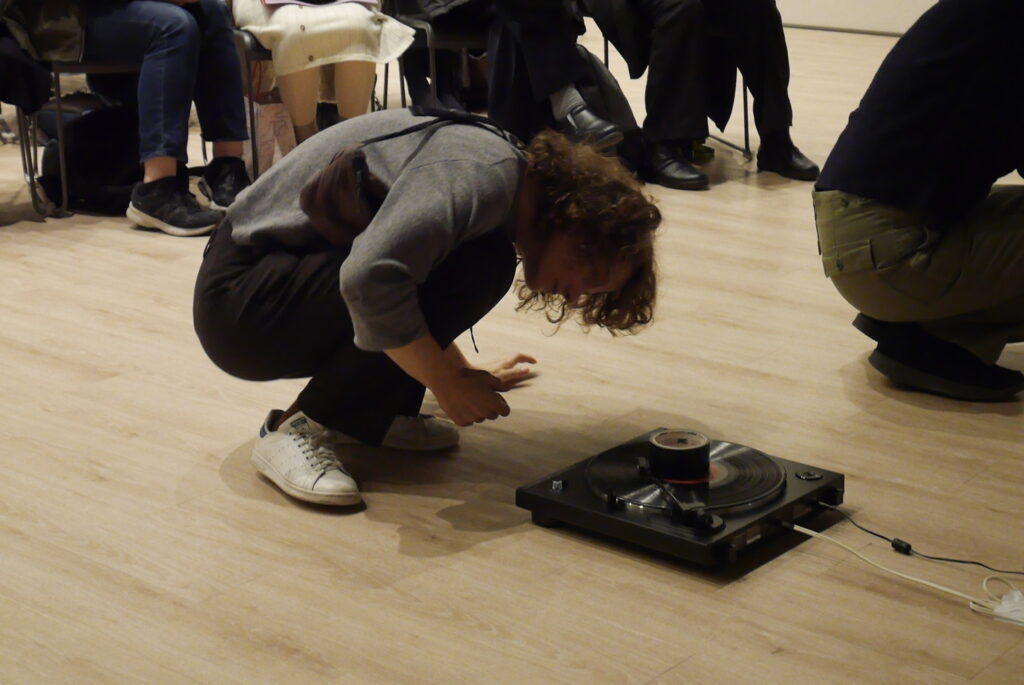
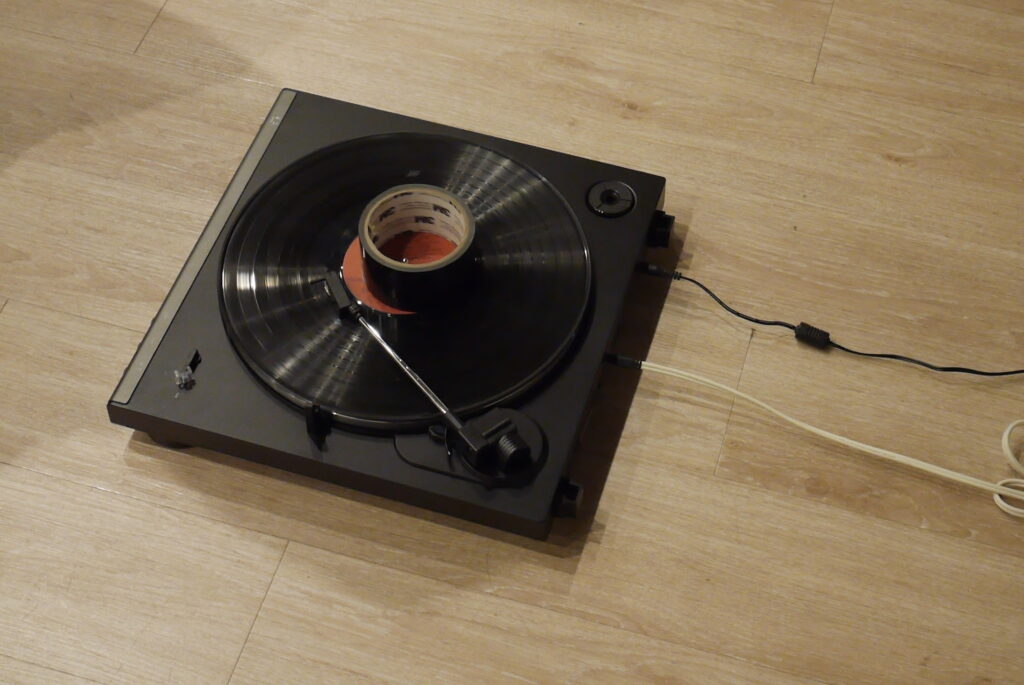
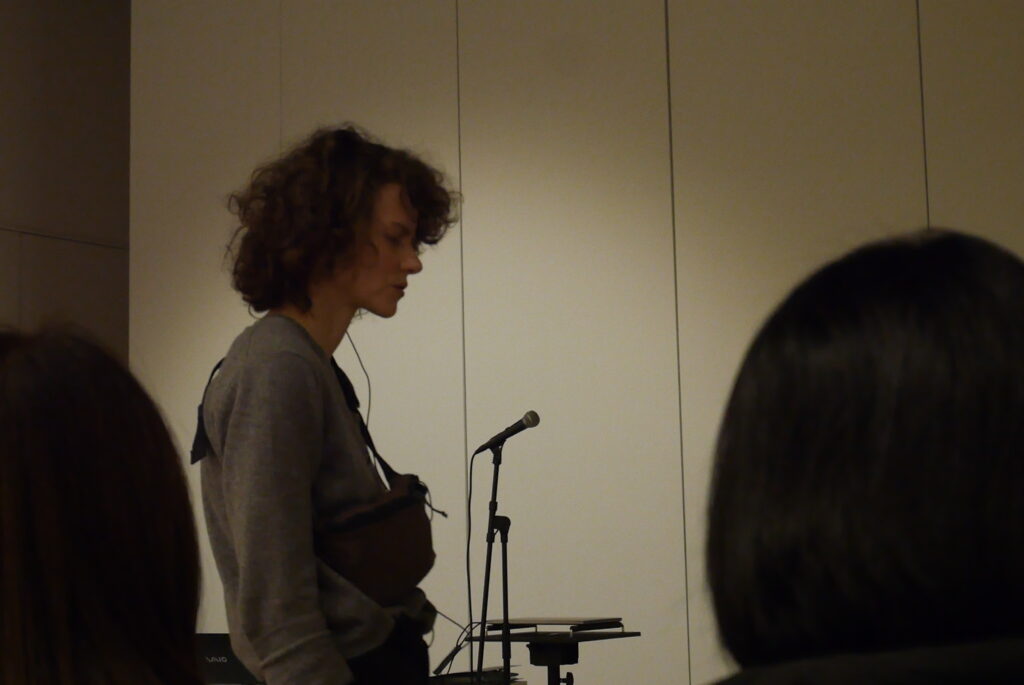
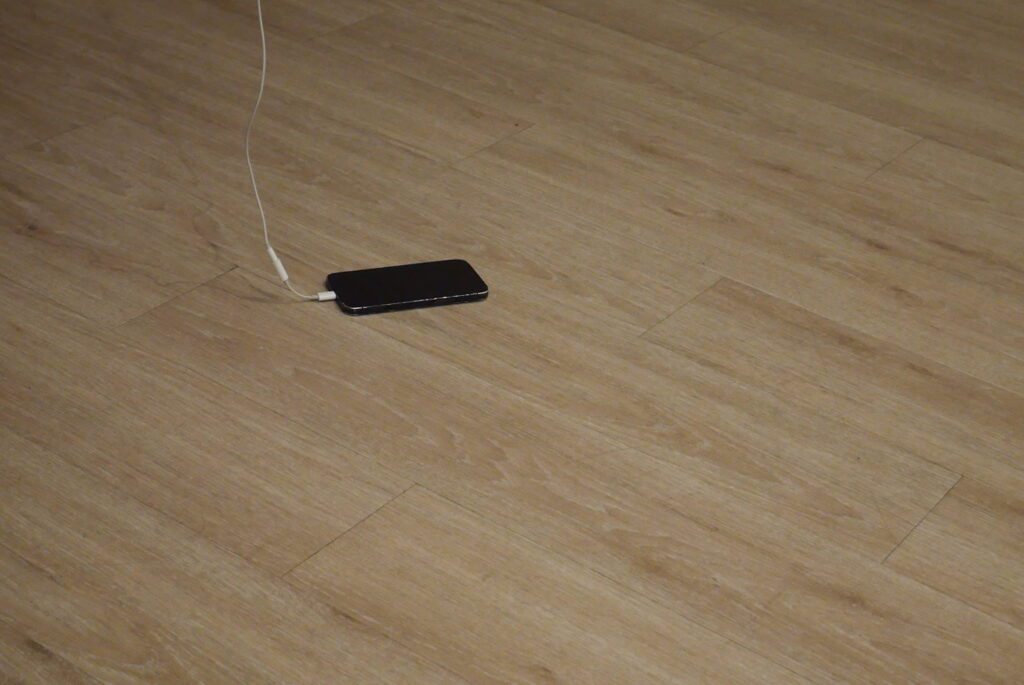
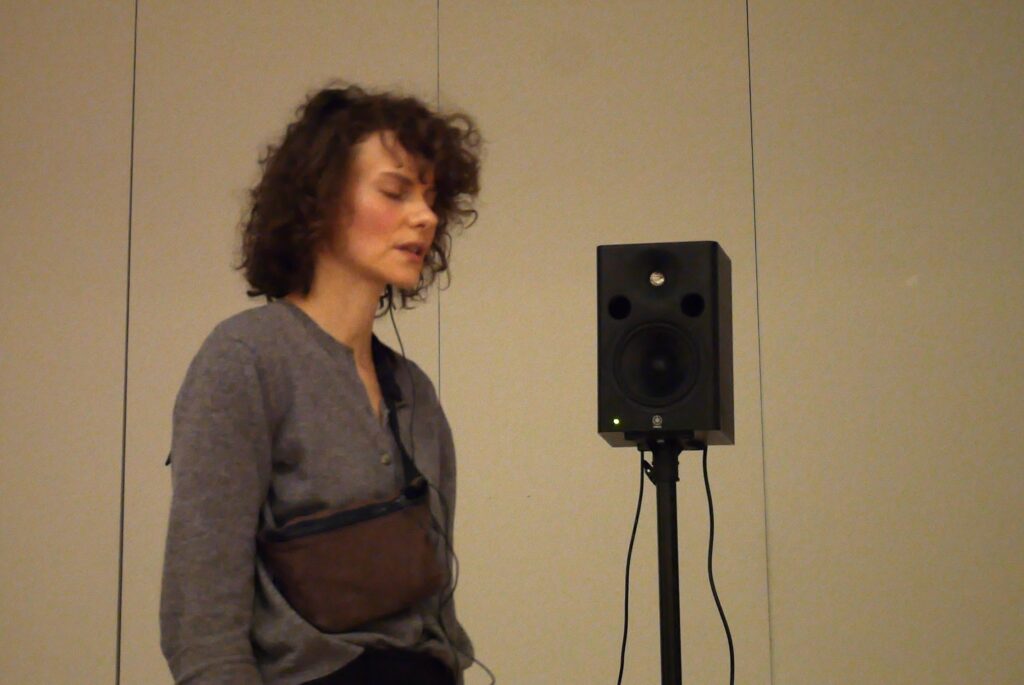
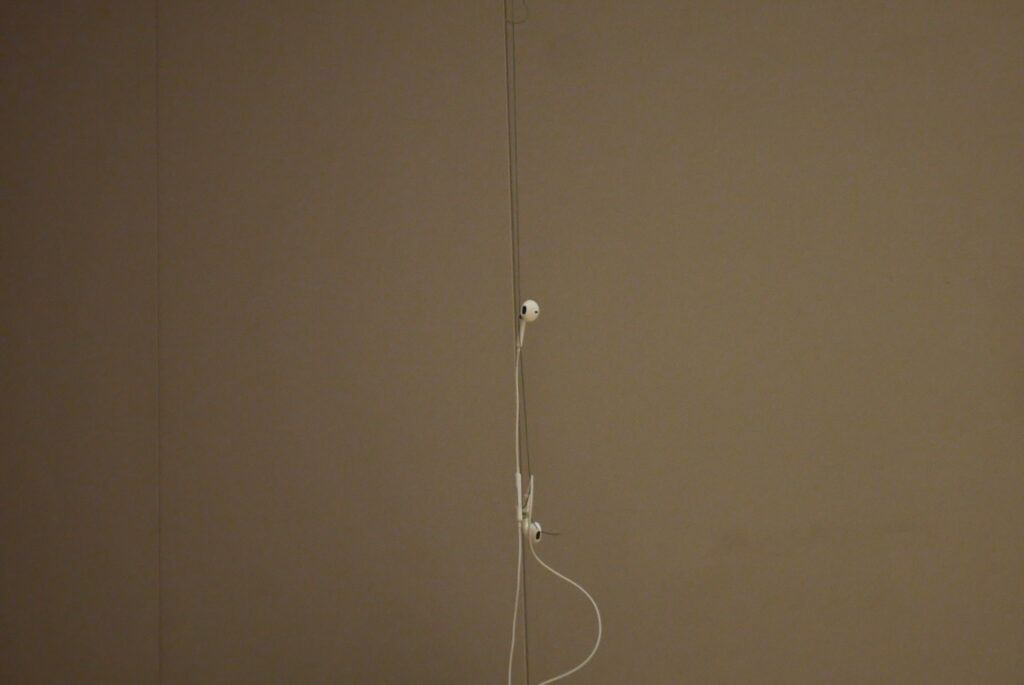
続くグリツューテさんは、グリナスさん協力のもと、ターンテーブルのセットとiPhoneを天井から吊るす作業に入ります。照明が落とされ、規則的なリズム音がチクタク鳴り始めると、会場は一瞬で静かに。そこへマイクでも拾いきれないくらいの小さな声で、グリツューテさんが英語の詩の暗唱を始めます。
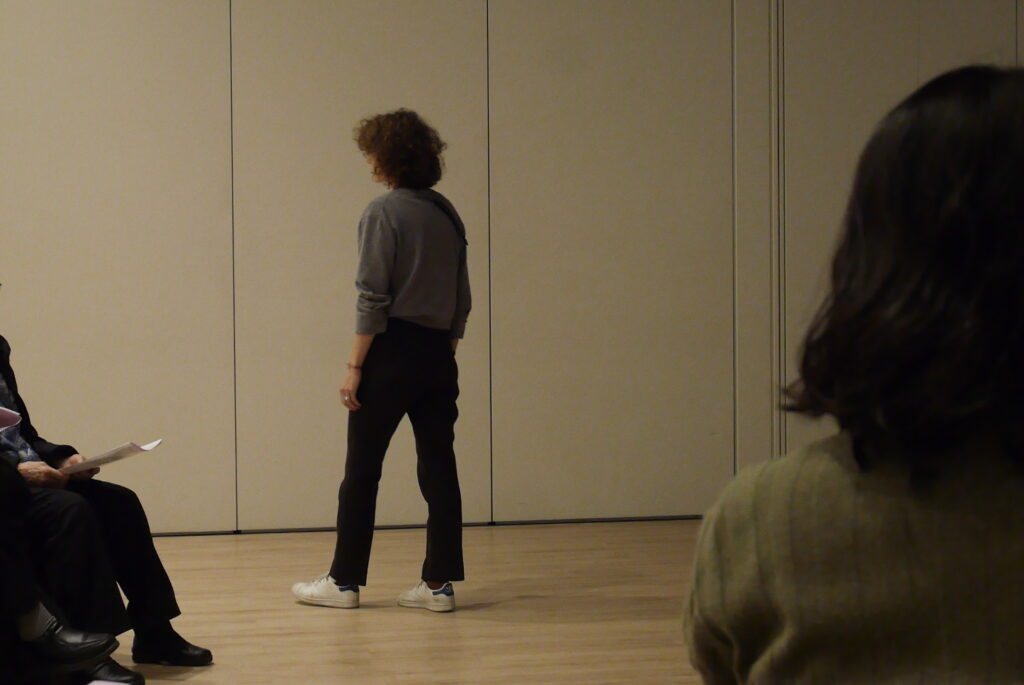
グリツューテさんが何十回も席のあいまを同じルートで練り歩くと、そのたびに同じ詩の違う箇所がグリツューテさん付近の人たちに聞こえてきます。私の席から聞こえた文言を繋ぎ合わせると、「出産に伴って大きな苦痛を感じながらも鎮痛剤を拒否し、医師や周りの病棟患者を閉口させる人の話」ができあがりました。でもきっと、たまたまそういう形になっただけです。他の箇所が聞こえていたら、まったく別の話として理解されたかもしれません。
小さな小さな声で暗唱が繰り返されるあいだ、iPhoneに繋がれたイヤフォンからもなにか微かに音漏れが聞こえていたのですが、微かすぎてそれがなんなのかまったくわからないくらいでした。よく考えるとグリツューテさんの暗唱も、立派な詩を載せて大衆に聞かせるなんてつもりのない、小さな音漏れみたいなものだったのでしょうか。座っている人たちは、メッセージが伝達されてこないせいで最初は「聞きたいものが聞きたいように聞こえない」という不具合に直面したかもしれませんが、時間のおかげで音声が予期せぬ形でまとまりをみせていったところは、確かに出産育児という経験の根本的な予測不能さと通じる気がします。
With Gurinas’ assistance, Gailė Griciūtė began setting up a turntable set, suspending iPhones around from the ceiling. As the lights dimmed and a steady rhythmic ticking began, the venue instantly fell silent. Then, in a voice too low even for the microphone to catch, Griciūtė began reciting a poem in English.
As the artist walked the same route dozens of times between the seats, different sections of the poem were delivered to the people near her. Piecing together the lines I heard from my seat, the story that emerged was of “a person who, despite experiencing immense pain of childbirth, is refusing pain killer, leaving the doctor and other patients exasperated.” What it was that it just happened to form that way. If other parts had been heard, it might have been understood as a completely different poem.
While the recitation repeated in a voice that’s soft and low, some sound was faintly leaking from the earphones connected to the iPhone. It was so faint I couldn’t tell what it was at all. Throwing back, perhaps Griciūtė’s recitation was also like that slight sound leakage—not intended to present a grand poetry to the mass audiences. Those seated might have initially faced the glitch of “not hearing what they wanted to hear the way they wanted” because the message wasn’t being conveyed. Yet, over time, the sound unexpectedly came together in different unexpected forms. This certainly resonates with the fundamental unpredictability of the experience of childbirth and child-rearing.
⛈️アルトゥラス・ブムシュテイナス《Bad Weather Navigations 2017-2025》/ “Bad Weather Navigations 2017-2025” by Arturas Bumšteinas
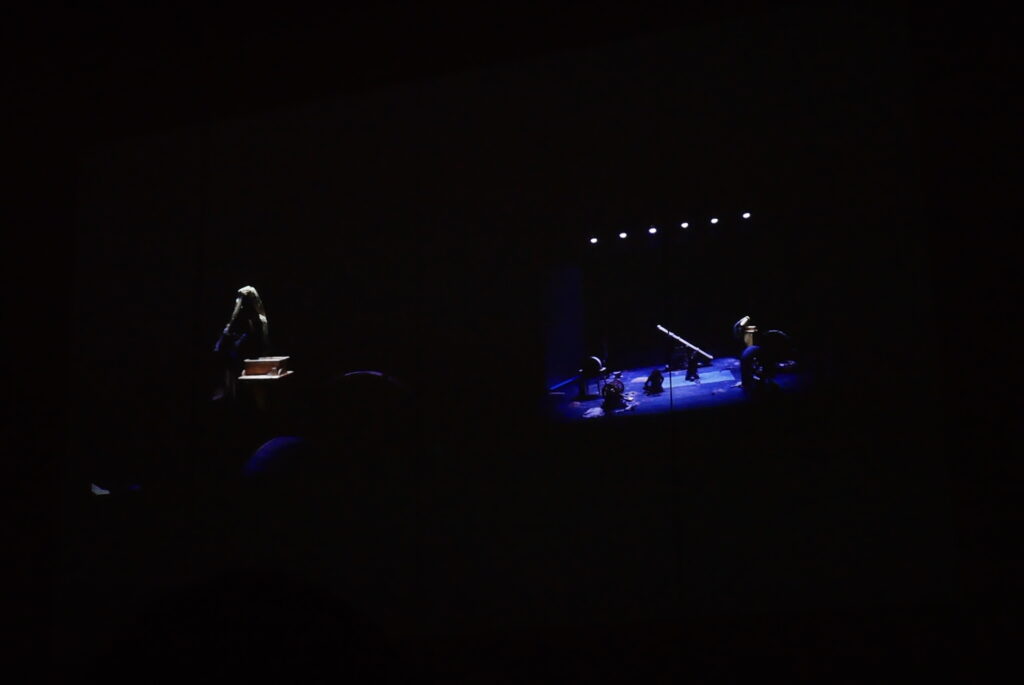
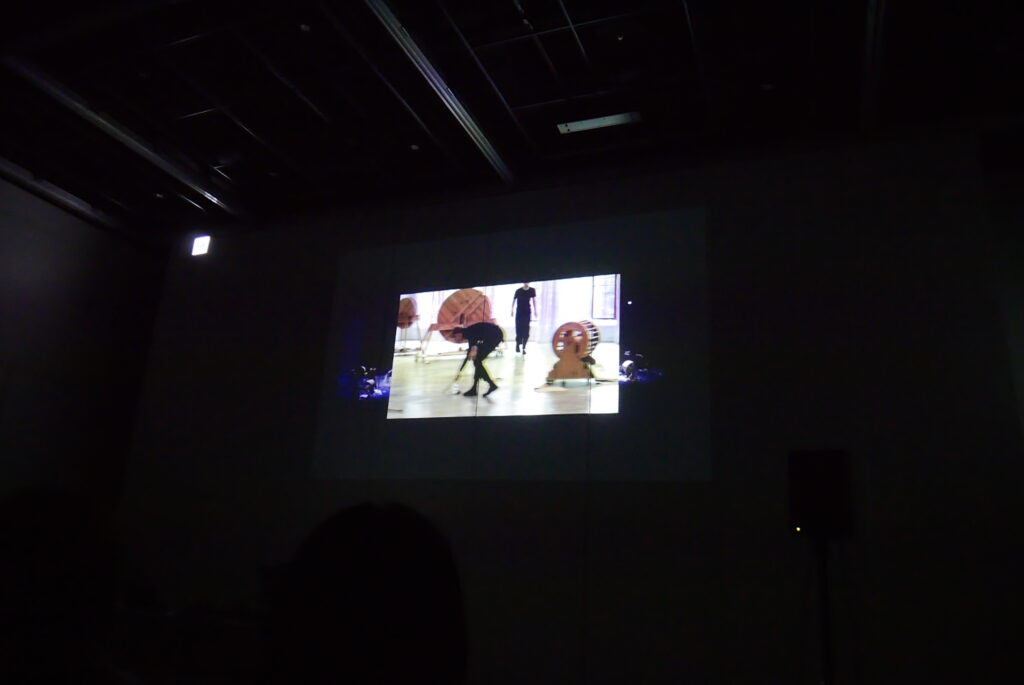
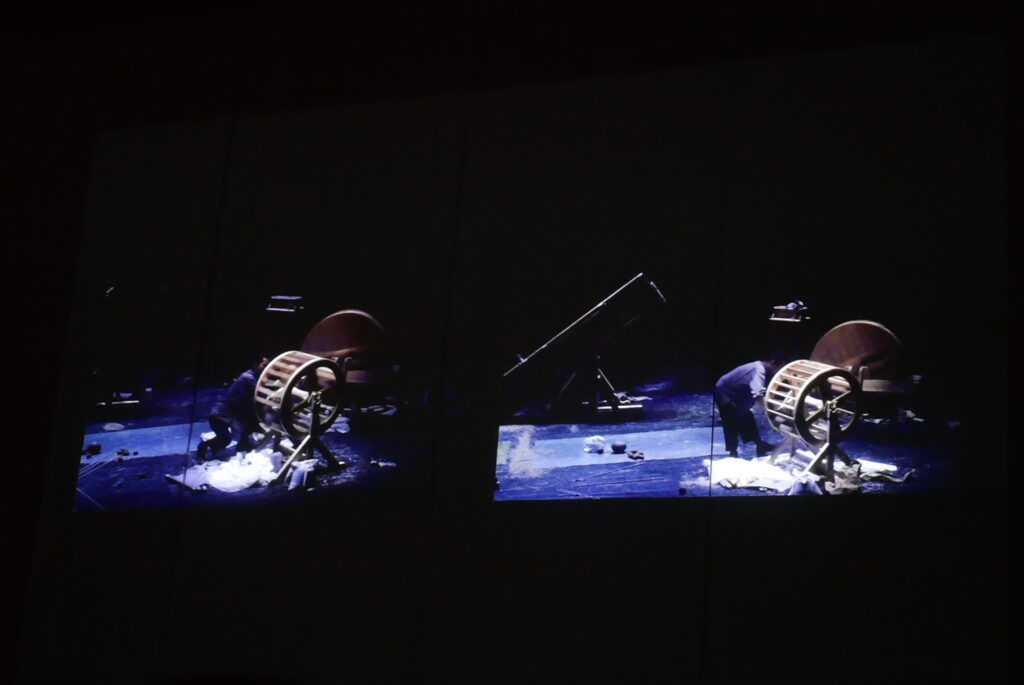
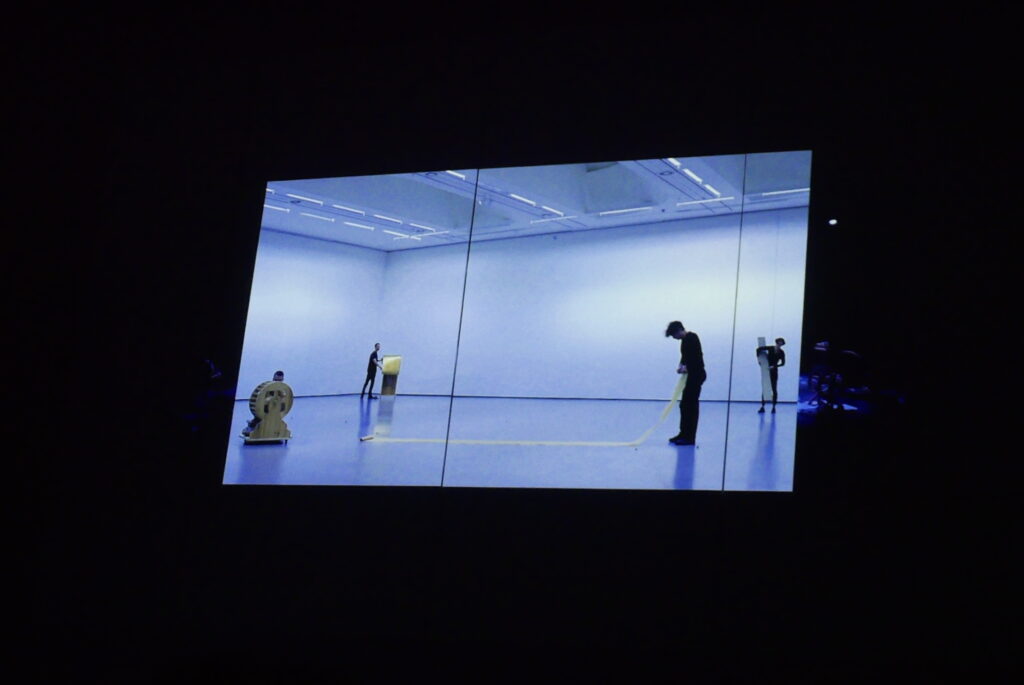
生前のメカスと会ったことがあるというブムシュテイナスさんは、かつてバロック劇場で使われた音響装置を現代のパフォーマーたちが動かすサウンドアート作品《Navigations》(2017~2025にツアーとフェスティバルで複数回上演)の映像記録を再構成した《Bad Weather Navigations 2017-2025》を上映しました。
会場で配布されたパンフレットによると、この装置は「「風・雨・雷の音を再現するよう設計されている」とのこと。複雑な楽器みたいな見た目のものもあれば、硬い粒上の物体が入った容器/装置を人が振るうことでざーーーという雨音が再現されるシンプルな仕組みのものも見られました。
冒頭で少し触れたメカスの『ウォールデン』では、ニューヨークの名士たち(地元の有力政治家や市長ら)がメカス含む市民を引き連れてオルムステッド邸という地元の名所をハイキングする箇所がありますが、政治家たちの楽しそうな雰囲気とは不釣り合いなことに、音声面ではなにかの轟音が断続的に鳴っています。一度音が途切れてまたカットインするときには、爆発音さながらのインパクトが発生します。これがなんの音か具体的にはわからないのですが、メカスがヨーロッパでの難民生活中に日記のなかでさんざん呪った爆撃機の轟音の再演であるような気もします。映像から流れる嵐の音も爆撃(っぽい)音も、危機的状況で聞こえる環境音の再現だと仮定してみると、「危機」のテーマが人それぞれに解釈され再現されるときの繊細な多様さに気づかされます。
舞台上を行き交うキネティックな音響装置ですが、大型なこともありそれを力いっぱい動かす人々の疲れも感じられて、人が装置に動かされているふうに見えてきます。そうすると、だんだん装置より人のほうが気になり始めます。ふるめかしい装置の技術的クリシェのすきまに、それを取り巻く人間の身体の動きや空間の壮大さを見出す分析能と、それをパフォーマンス作品や映像作品へ展開する手法の独自性。ブムシュテイナスさんの匠みな手腕を感じました。
Arturas Bumšteinas, who blessingly had met Mekas in person, screened his moving image work “Bad Weather Navigations 2017-2025.” The piece reconstitutes video recordings of Bumšteinas’ Navigations (2017–25), a sound art piece performed multiple times at tours and festivals. In the performance stage, performers carefully and deliberately operate acoustic sound devices once used in Baroque theaters.
According to the brochure, the sound apparatus was “designed to reproduce the sounds of wind, rain, and thunder.” Some resembled complex instruments, while others featured rather simple mechanisms: containers or devices filled with hard granular objects that, when shaken by humans, reproduced the sound of rain.
In Mekas’s Walden, briefly mentioned earlier, there’s a scene where New York dignitaries (local influential politicians, the mayor, etc.) lead citizens, including Mekas, on a hike through the local landmark, the Olmsted House. Jarringly mismatched with the politicians’ cheerful atmosphere, the audio features intermittent booming sound. When the sound cuts out and then cuts back in, it creates an impact akin to an explosion. While the specific source of this sound remains unclear, it feels like a reenactment of the bomber roar that Mekas cursed relentlessly in his diary during his refugee life in Europe. Assuming both the storm sounds and the (seemingly) bombing noises emanating from the footage are recreations of environmental sounds heard in crisis situations, one becomes aware of the delicate diversity in how the theme of “crisis” is interpreted and reproduced by different artists.
The kinetic sound devices moving across the stage are gigantic, and gradually you can sense the fatigue of the people moving them with all their strength. It begins to look as if the people are being pushed and pulled by the devices. It won’t take so long to see humans replace the sound devices in the audience’s priority in cognitions. The analytical ability to discern the movements of human bodies and the grandeur of space within the gaps of the technical cliché of the rustic apparatus, coined with the unique approach of developing the sound instruments into performance and video works. In all that I sensed the masterful skill of Bumšteinas.
おわりに
ここではリトアニア関係の作品をご紹介しましたが、今回のイベントではもう1本、映像作品『CAVE DANCE — 舞踏映像と電子音響音楽作品』(2023)も上映されました。こちらは舞踏家の大野一雄が弟子たちと共に取り組んだ《O氏の死者の書》(1973、長野千秋・大野一雄)の再編集バージョンで、映像の再編集と音楽制作を向山さんが担当しました。映像が始まると、舞踏関係者を中心に来場のみなさんの熱気が増すのを感じました。
今回上映・上演された5作品は、独自の関心がはっきり表れた野心作ぞろいでした。リトアニアといえばメカス、マチューナス、で私の認識は止まっていたのですが、どんどん新しい表現が生まれている現在地を目の当たりにして、もうワクワクがとまりません。リトアニアにはいまどんなアートシーンがあるのか……AIR-Jによると、リトアニアにもいくつかレジデンスがあるようです。要チェックです。
改めて、ブムシュテイナスさん、グリナスさん、グリツューテさん、素敵な上演・上映をありがとうございました🌿
(五十嵐 千夏)
In this article introduced are the ones related to Lithuania only, but the event also screened another kind of film work: “CAVE DANCE — Butoh Film and Electronic Music” (2023). It was a re-edited version of The Book of the Dead of Mr. O (1973, Chiaki Nagano & Kazuo Ohno), a project undertaken by butoh dancer Kazuo Ohno with his disciples, on screen at the event. For this version, Chiharu Mukaiyama was responsible for re-editing and music production. As the film began, I felt the entire room get excited, particularly regular audiences and practitioners of Butoh.
All five works screened and performed for the occasion were aspiring and ambitious, clearly driven by unique artistic visions. My knowledge of Lithuanian art had stopped at Mekas and Maciunas, but witnessing the vibrant new expressions emerging at the showcase has me absolutely thrilled for what the contemporary Lithuanian art scene holds. According to AIR-J, there seems to exist several residencies in Lithuania — in case you’re also fascinated by the three artists’ creative pursuits, we highly recommend you to look up at and apply for some.
Congratulations on Alanas, Gaile, and Arturas for the spectacular performances and screening 🌿
— Chinatsu Igarashi